Spam is a marketing channel too, just a dishonest one. And like any marketing, some of it is competent and some of it is embarrassing. This one is the second kind: an email telling me I had won $55,000,000 in an imaginary Yahoo lottery. It is worth a look, because the reasons it fails are the same reasons real campaigns fail.
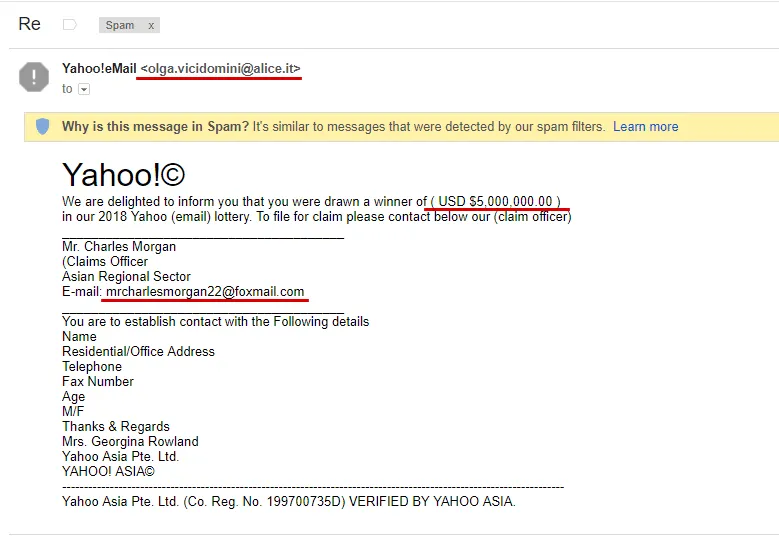
We are delighted to inform you that you were drawn a winner of! USD (55,000,000.00)
in our 2018 Yahoo (email) lottery. To file for claim please contact below (claim officer)
Mr. Charles Morgan
Yahoo Asia Pte. Ltd. (Co. Reg. No. 199700735D) VERIFIED BY YAHOO ASIA.
A spam Yahoo lottery scam email
Look at the trust signals, or the lack of them. One message uses three different names, two email addresses and three unrelated domains. No brand can survive that. The first rule of getting someone to act on a message, spam or not, is consistency: one sender, one identity, one recognizable name. Break it and even the least suspicious reader senses something is off. This scammer failed at the exact thing every legitimate marketer has to get right.
For a more entertaining study of the genre, watch James Veitch’s talk. Instead of deleting the scam on sight, he replies and narrates the months-long exchange that follows. It is funny and it is also a quiet lesson in how thin the persuasion really is once you engage with it.
The takeaway holds in any inbox: trust is built on consistency. The moment your signals contradict each other, you have lost the reader.
Written by Valon Badivuku, who works on enterprise web and search and
builds his own products. See his work and
playground.

Write a comment