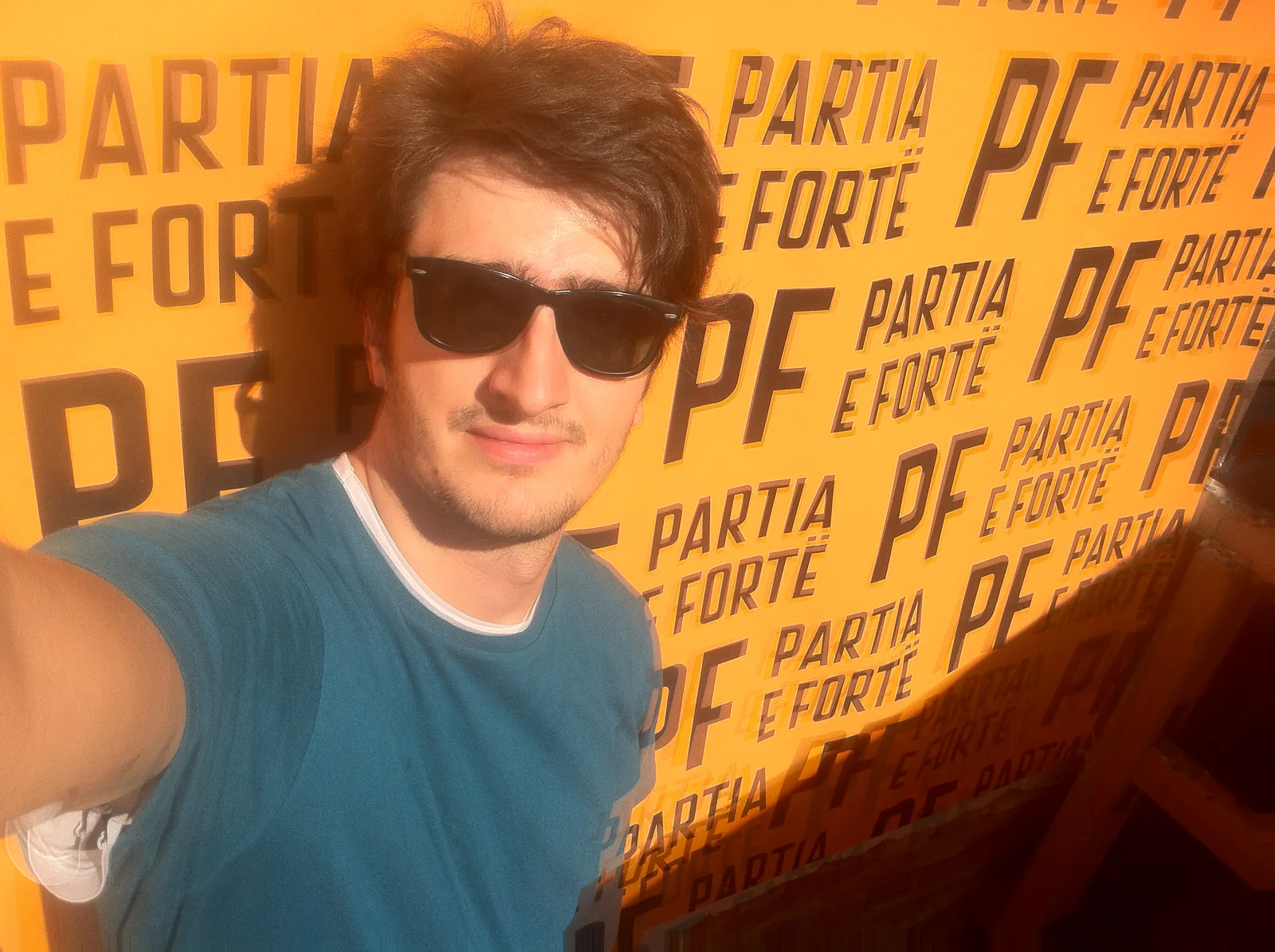
There is a version of this story where a satirical party is born from a single clever tweet. That is not how it happened for us. Partia e Fortë started the way a lot of good and stupid ideas start in Pristina: a room full of designers, artists, a couple of people who could write and a shared feeling that the politics we were living through had become impossible to argue with seriously.
So we decided to stop arguing seriously.
The premise we landed on in November 2012 was simple and, I still think, brilliant in its stupidity: a party whose entire platform is that everything in Kosovo is already perfect and that the smartest thing anyone can do is keep it exactly the way it is. A party that promises everything, to everyone, always, because promising is the whole job. “Ne gjithmonë premtojmë.” We always promise.
I came into it from the digital side. I am not a graphic designer and I am not a philosopher, both of which were in the room. What I could do was think about how a message travels online, who shares it and why and how you turn a joke told among ten people into a joke told among ten thousand. Somebody had to own that. I put my hand up. So now I am the one thinking about the digital side of a party that does not want power, only attention, so it can hold a mirror up to the people who do. Nobody in the room has done anything like this before. There is no manual for making a fake political party go viral in Kosovo. We are working it out as we go. Honestly, it is already pulling more attention than any of us expected.
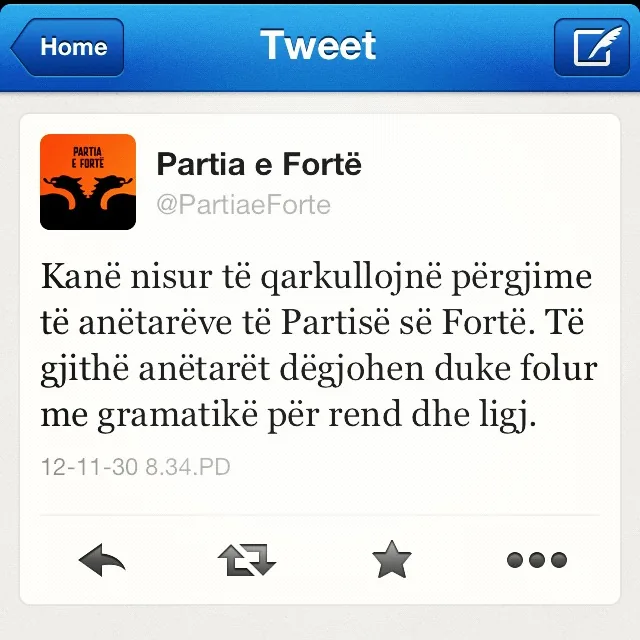
That tweet is dated 30 November 2012, which tells you the voice existed months before the election paperwork. We were already in character on Twitter while the party was still, on paper, nothing at all.
What made the early meetings work was that nobody was precious. If a line was not funny, it got cut. If an idea needed a poster, someone made a poster by the next day. The satire only works if it is faster and sharper than the thing it is mocking. Real political parties are slow. That was our whole advantage. Most of my early thinking was just: how do we stay fast.
We had been talking about the idea since 2011, but the party itself only came together now, at the end of 2012. We were not on any ballot yet. That came later, in June 2013, when the Central Election Commission registered us for elections and the joke suddenly had legal standing, which was its own kind of comedy. But the thing itself, the voice, the logic, the refusal to break character, all of that was decided in those first rooms at the end of 2012.
I will write more as we go, because this is already turning into a real education in how attention works. But it starts here, with a group of people deciding that the most honest thing they can do is to be completely, relentlessly insincere.
Write a comment