Social media work is invisible work. That is most of its appeal, honestly.
For two years I ran Partia e Fortë’s channels from behind the screen. I picked the timing, wrote in the voice, decided what we jumped on and what we let pass. When something landed, the party got the credit, which is exactly how it should work. The whole craft is making things happen without appearing in them.
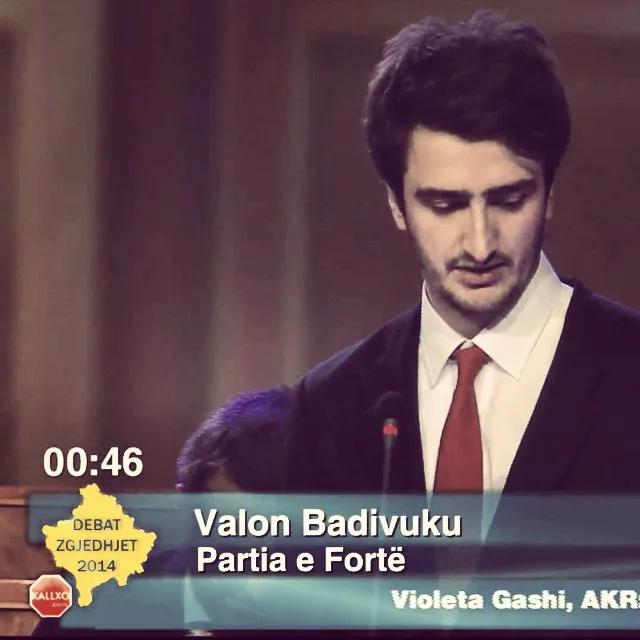
Then, during the 2014 campaign, I found myself at a podium under studio lights on national television, with my own name and the party’s on the screen underneath me.
The comfortable distance goes away
Behind the feed you have every protection. You have time. You can draft the post, look at it, cut the line that is not quite working and publish the better version. If something goes wrong you can delete it. Nobody sees you think.
Live television takes all of that at once. The question arrives, the camera is already on and whatever comes out of your mouth is the party’s position now, in front of an audience that did not choose to follow you. There is no edit, no draft, no deleting the bad take.
And the thing you cannot prepare for is that you are not operating the channel anymore. You are the channel. Every instinct I had built was about shaping how someone else came across. None of it covered how I came across.
What actually got me through it
Not media training. I had none. What carried it was that the material was already finished.
Two years of daily posting meant the voice was not something I had to compose under pressure. It was reflex. Every promise the party could make had already been made, in public, in a form I had usually written or shaped myself. Under lights with a clock running, you cannot invent. You can only reach for what is fully formed. It turned out the background work had been the rehearsal the entire time.
The catalogue was real and it was specific. My favourite piece of it is a postcard promising a motorway between Arbëri and Bregu i Diellit. Two neighbourhoods of Prishtina, minutes apart. Rendered as a glowing multi-lane highway with the official green motorway sign, party logo in the corner, slogan across it: gjithmonë premtojmë. Always promising.
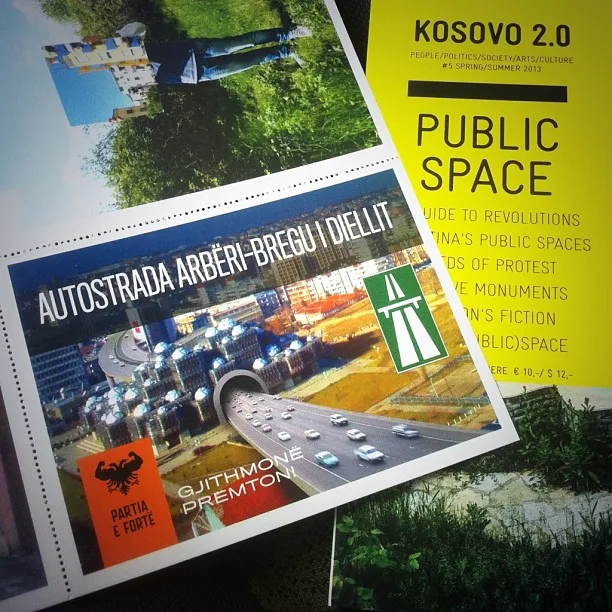
That one ran in Kosovo 2.0’s Public Space issue. It is a joke about infrastructure as spectacle: the ribbon, the render, the grand announcement, all aimed at a distance you could walk. Everyone in Prishtina got it instantly, because everyone had seen the real version.
So when the debate questions came, I was not defending a position I had to think up. I was quoting a body of work. Whatever anyone else pledged, we could pledge more of it. The more sincerely I said it the better it worked.
Why the camera was worth it
Online, the party could always be filed away as an internet thing. Funny page, clever kids, not real politics.
Television removed that option. Once you are in the chair, you are inside the frame, taking the same questions in the same tone as parties that meant every word. Nobody in the audience gets to decide the joke is happening off to the side somewhere. It is happening in the middle of the broadcast, on the national channel, in a suit.
That reach was not something I could have engineered from the feed. No amount of good posting gets you into that room. Being a certified candidate does. I wrote about that decision in Candidate Number 10.
The part I keep
If you do this work long enough, the moment comes when the thing you built needs a face and the only person who understands it well enough is you. You can hand it to someone more polished and watch them get the tone slightly wrong, or you can go stand in the light yourself.
I am glad I went. Being uncomfortable on camera for an hour is a small price for finding out that the invisible work was never separate from the visible kind. It was just the part that happens first.
Write a comment