It would be easy to remember Partia e Fortë as pure silliness: baklava spots, absurd promises, faces on posters. But the party had a sharper register too. Some of the work I am proudest of used the same deadpan voice to say something genuinely pointed about the society around us.
“Manual për Burra” is the clearest example.
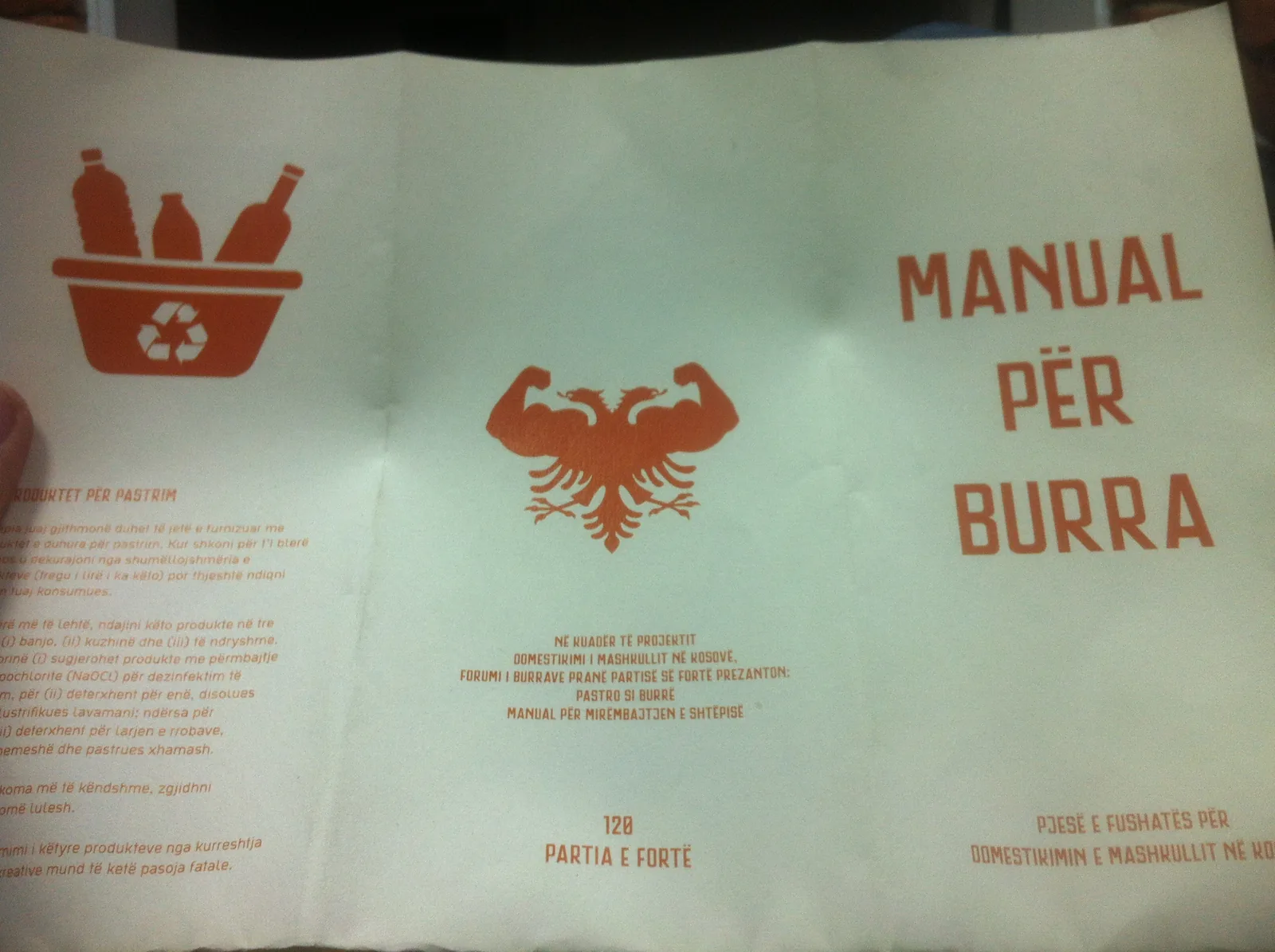
On its face it is a straight-faced instructional pamphlet, a “manual for men,” teaching them how to clean a house: which products to buy, how to sort them, how to keep things tidy. It was presented under the banner of a project on, in the party’s mock-bureaucratic language, “the domestication of the male in Kosovo.” The humor is in the register, an earnest how-to guide for grown men on tasks that, in a lot of Kosovar households, men had simply never been expected to do.
The joke points straight at a real thing: a deeply gendered division of domestic labor that most people never questioned out loud. By producing a completely serious “manual” teaching men to do housework, we made the underlying assumption visible and a little ridiculous. You laugh and then you notice why it is funny. The why is the actual argument. That is satire doing the job that a lecture cannot. Nobody shares a lecture about gender roles. People shared a solemn pamphlet teaching men how to use dish soap.
Working on the digital side, this taught me something about range that I have never forgotten. A voice that is only ever silly gets ignored the moment it tries to matter. But a voice that has earned its comedy can, occasionally, turn that same comedy on something real and land it harder than any earnest campaign could, precisely because people are not braced for it. The audience came for the jokes. That is exactly why the pointed pieces reached them.
There is a discipline to it, though. We mostly kept to it. The target was always a structure or an attitude, never a vulnerable group. “Manual për Burra” pokes at the men who had never lifted a finger at home and at the assumptions that let them, not at anyone who deserved sympathy. Satire that punches up at a comfortable norm is illuminating. Satire that punches down is just cruelty wearing a joke. Knowing the difference is the entire ethics of the work.
This is the thing I am learning, campaign by campaign, with no one to teach it to me. You earn people’s attention with things that delight them and then, once in a while, you get to spend that attention on something that actually needs saying. The delight is what buys you the hearing.
More on the party’s substance: why a joke party was serious civic work and the youngest, most gender-balanced list in Prishtina.
Write a comment