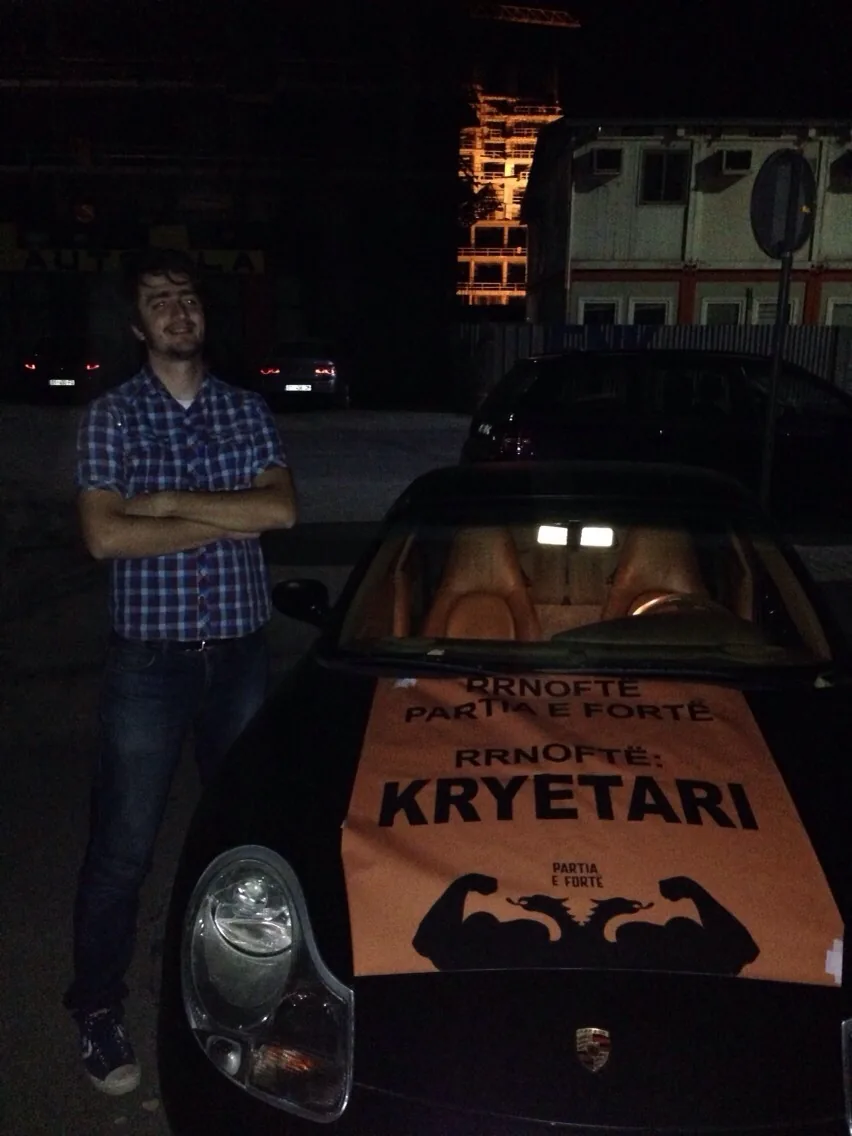
Partia e Fortë came to an end in 2019. Planned in 2011, established in 2012 and registered with the Central Election Commission in June 2013, it wound down roughly six years after that registration. I have spent some time since trying to make sense of why a thing that worked so unusually well eventually stopped. I have landed somewhere that surprised me: the ending is the part I respect most.
A satirical party lives on a contradiction. Its power comes from being outside the system, throwing rocks at it, refusing the seriousness that everyone else performs. But the more successful it gets, the more it is pulled inside. You win a seat. You file candidate lists. You get covered by international press as an institution. Slowly the outsider becomes a fixture. A fixture cannot credibly mock fixtures. The joke depends on distance. Success closes the distance.
There is also the simpler, human truth. The people who build something like this are mostly volunteers giving their time because it is meaningful and fun. Years pass. People’s lives move. Careers, families, other countries, other fights. I ended up in California, a long way from a room in Pristina in 2012. The energy that a volunteer movement runs on is real but it is not infinite. There is no shame in a thing ending when the people who made it move on to the next chapter.
But here is why I think the ending was honest rather than sad. Partia e Fortë’s entire message was about impermanence disguised as permanence, about how the political class treats itself as eternal and unquestionable. A party that ran on that critique had no business becoming eternal itself. Overstaying would have made it the thing it mocked: an institution clinging to relevance, still promising, long after the moment that gave it meaning had passed. Ending on its own terms was the most in-character thing it could possibly do. It refused to become a permanent fixture, which is exactly what it had spent years telling everyone else to refuse.
For me, the whole arc, start to finish, taught me most of what I know about how movements actually work. I wrote the tactical lessons down as they happened, distribution over production, voice as discipline, timing, the honest gap between attention and votes. The ending adds one more:
Know what your thing is for and be willing to let it end when it has done that job. Most people cannot. Most organizations, most campaigns, most careers keep going long past their point because stopping feels like losing. Partia e Fortë started as a joke about people who would never let go of power and it finished by letting go of its own. I do not think that was an accident. I think it was the last, best joke and it happened to be true.
If you are reading the whole set: it begins with how we started and runs through what it taught me about social media strategy.
Write a comment