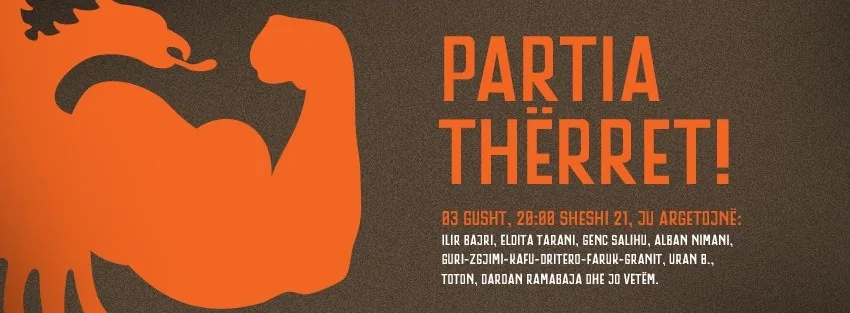
People sometimes asked us, usually with a slightly disapproving tone, whether we were not making a mockery of a serious thing. Democracy is serious. Elections are serious. And here was a party promising nothing, mocking everything, treating the whole apparatus like a punchline. Was that not corrosive?
I always thought it was the opposite and I still do. Partia e Fortë was some of the most serious civic work I have been part of, precisely because it was funny.
Here is the case, as I came to understand it from the inside. A lot of young people in Kosovo in 2013 had checked out of politics, not because they did not care but because caring felt useless. The serious parties had taught them, election after election, that engagement led to disappointment. Cynicism was the rational response. And a fully cynical generation is a gift to whoever is already in power, because it does not participate and does not push back.
Satire is what cynicism becomes when it decides to show up anyway. When you laugh at power together, in public, you are doing something that pure cynicism never does: you are participating. You are saying the situation is absurd and also refusing to be silent about it. Every share of one of our posts was a small act of political engagement by someone who had probably decided that regular political engagement was pointless. We gave people a door back into caring. The door was a joke because that was the only door they would walk through.
That is why the seat mattered so much as a symbol. It was proof that the laughter had been a real political feeling all along, not an escape from politics but a form of it. The people who voted for us were not throwing their vote away. They were casting the most precise vote available to them, one that said “none of you. Here is exactly why.”
I think about this a lot, because the tools we are using, social platforms, viral content, memes, get talked about mostly in terms of manipulation and damage. And they can do damage. But I am watching those same tools give a disengaged generation a way to speak to power that feels native to them, that they actually use, that just ended in a real democratic result. The medium is not the problem. What you do with it is.
My contribution to Partia e Fortë was on the digital and social side. For a long time I described it to myself in purely tactical terms, reach and voice and timing. But the reason the tactics were worth getting right is that they were in service of something that mattered. We were not just being clever. We were lowering the cost of caring, in a place and a moment where caring had gotten very expensive. That is the part I am proudest of. It is the part that has nothing to do with any metric.
Write a comment