Most political slogans are promises. Ours was a promise about promising. “Ne gjithmonë premtojmë.” We always promise. That is the whole campaign in three words and it might be the cleanest piece of messaging I have ever seen.
Here is why it worked, from where I sat on the digital side.
A good slogan is memorable. A great slogan is memorable and does a second job while you are not looking. “We always promise” was funny on the surface, because of course a party would promise things. But underneath, it was pointing directly at the thing every voter in Kosovo already felt in their gut: that politicians promise endlessly and deliver nothing and that the promise itself has become the entire performance. We just said the quiet part with a smile.
Because the slogan was self-aware, it gave us an engine that never ran out of fuel. Any real promise a real party made, we could match and exceed, absurdly, sincerely, in character. You are promising jobs? We promise everyone a job, two jobs, a job for your cousin. You are promising highways? We promise highways to places that do not exist yet. The format was infinitely repeatable. Repeatable is exactly what you want when you are feeding a social channel every single day.
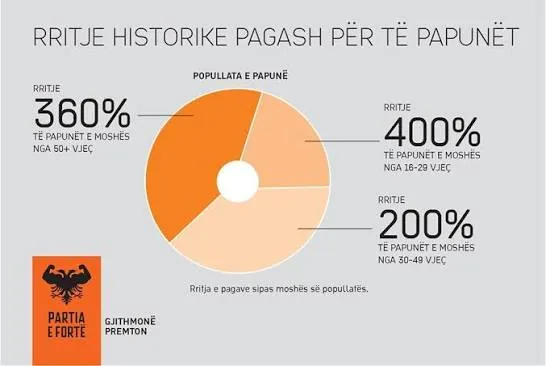
We took the format everywhere, including into the visual language of real policy. One of my favorites was an infographic promising a “historic salary increase for the unemployed,” complete with a serious-looking pie chart: a 400 percent raise for the young, 360 percent for the old, 200 percent for everyone in between. A raise, for the unemployed, who by definition have no salary. It looked exactly like a real party’s economic pledge, which was the joke and it carried our slogan at the bottom: gjithmonë premtojmë. Always promising.
That is the part I want other people who do this work to take away. A slogan is not a decoration you put at the bottom of a poster. If you choose it well, it is a content system. “We always promise” told me what to post when I had nothing to post. It generated material. On a slow news day I could reach for the format and the format never failed, because grandiose empty promises are the one renewable resource in politics.
It also gave supporters a way to join in. People started making their own promises in our voice, tagging us, competing to be the most absurd. That is the dream outcome of any campaign message: you hand people a template and they build your movement for you, for free, because it is fun. My job stopped being to produce all the content and became to curate the best of what people were already making and hand it back to them bigger.
The seat we eventually won in Pristina got the headlines and it should have, it was a genuinely surreal outcome for a joke. But the seat was downstream of the slogan. Long before anyone voted, “We always promise” had already done the hard work of making a satirical party feel like the most honest voice in the room. That is the paradox I keep coming back to. By promising everything and meaning none of it, we ended up saying something truer than the parties who meant to be believed.
Write a comment